1979 · Concerto for solo bandoneon and orchestra The music, its history, and why it belongs to the bandoneon
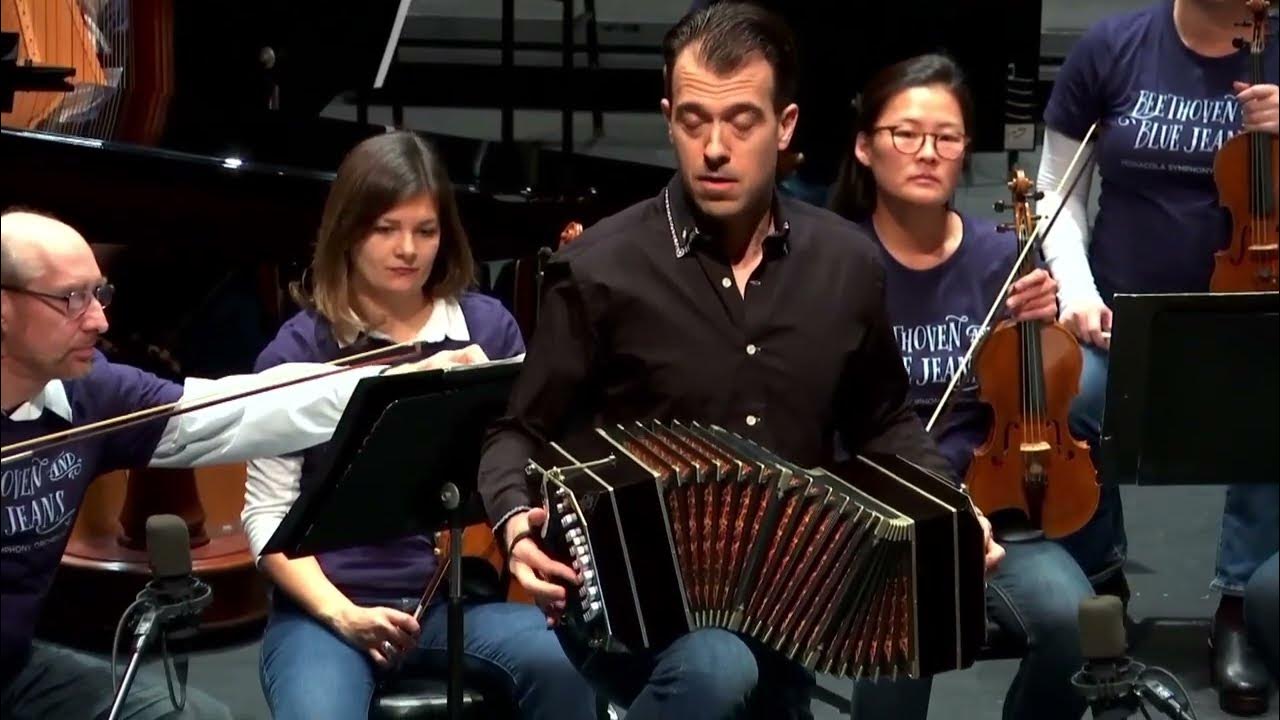
Aconcagua is Astor Piazzolla’s bandoneon concerto, written in 1979 for the bandoneon, not the accordion. It brings the expressive intensity of tango into the concert hall, placing the bandoneon at the center of a vivid orchestral landscape that moves from driving rhythms and virtuosic cadenzas to lyrical, almost meditative passages. Julien Labro performs it on bandoneon with orchestras.
Lasting approximately 24 minutes, the concerto unfolds across three movements: Allegro marcato, Moderato, and Presto.
Watch Aconcagua
Excerpt from Astor Piazzolla: Aconcagua, I. Allegro marcato Julien Labro, bandoneon · orchestra
Piazzolla wrote Aconcagua in 1979 on a commission from the Banco de la Provincia de Buenos Aires, and played the solo part himself at the premiere on December 15, 1979, at the Auditorio de Belgrano in Buenos Aires, with Simón Blech conducting. He did not choose the title: his publisher later named the work for Aconcagua, the highest peak in the Americas, in Argentina. The concerto brings Piazzolla’s Nuevo Tango language into a symphonic setting, with the bandoneon at the center of a three-movement work.
The three movements
Aconcagua moves from a driving Allegro marcato, through a milonga-based Moderato, to a thunderous Presto.
I. Allegro marcato
Driving rhythms carry the opening movement, and a coda in 6/8 closes it. The bandoneon has two cadenzas, which give the soloist room to ornament freely over a simple harmonic sequence, in the manner of Piazzolla. The two mirror each other, though players generally stretch the second one further, as Piazzolla himself did.
II. Moderato
The middle movement slowly unfolds as a milonga, a dance form closely related to tango. It begins with a long, exposed bandoneon solo, almost Bach-like in its choral character. There is something distinctly organ-like in the writing here, recalling the bandoneon's German origins as a portable substitute for the church organ. The harp, violin, and cello gradually join the soloist before the rest of the orchestra enters, allowing the movement to grow organically from an intimate opening into a broader orchestral texture.
III. Presto
The finale begins with a thunderous orchestral statement before eventually giving way to a slow build led by the strings. Piazzolla uses string effects from the tango tradition here, including the látigo (the “whip”) and the tambor, a drum-like hollow sound produced by the strings. The slow section before the coda gives the bandoneon player a very different kind of opportunity: to reveal the instrument's lyricism, subtlety, and virtuosity. Though the music is slow, players often ornament the melody in the manner of Piazzolla himself, shaping the phrases with the expressive inflections that are so distinctive to the bandoneon. The music gradually gathers momentum until the final coda brings the concerto to its close.
The bandoneon and Aconcagua
Why the bandoneon?
Julien Labro plays both accordion and bandoneon. For Piazzolla, however, the distinction between the two instruments was fundamental to his music. “The accordion has an acid sound, a sharp sound. It's a very happy instrument. The bandoneon has a velvet sound, a religious sound. It was made to play sad music.” Astor Piazzolla, New York, 1988 · Le Grand Tango, p. 153
Can Aconcagua be played on accordion?
Aconcagua was written for the bandoneon, and Julien Labro performs it on bandoneon. The two instruments are related but have different keyboard systems, techniques, and sounds, and Piazzolla felt the difference mattered. In a 1990 interview for Uusi Suomi, Piazzolla said the accordion “would never do justice to the essence of our music.”
Bandoneon vs. accordion
The bandoneon and accordion belong to the same family of free-reed instruments, but their sounds and expressive possibilities are distinct. The bandoneon has a focused, sometimes almost breath-like sound, capable of shifting from delicate lyricism to a dry, percussive attack. Its bellows articulation gives phrases a distinctive vocal quality. These characteristics are central to Piazzolla’s music, where rhythmic precision and expressive inflection are inseparable. In Aconcagua, that character comes through in the rhythmic bite of the first movement, the almost organ-like solo that opens the second, and the ornamented, lyrical writing of the finale. Learn more about the bandoneon and accordion.
A note from Julien
I first came to Aconcagua through Piazzolla's own recording with the Orchestra of St. Luke's, conducted by Lalo Schifrin. I was later lucky to discuss that recording with some of the musicians who were at the 1987 session. Over the years, the concerto has taught me a great deal about the bandoneon itself. I play both accordion and bandoneon, and for this concerto the choice is easy: the music asks for the bandoneon.
In the long phrases of the second movement, the motion of the bellows becomes almost part of the melody, and a slight change of pressure can make a note swell, recede, or almost speak. The first movement's cadenzas invite the kind of ornamentation Piazzolla himself brought to them, and the second movement opens with a stillness and intimacy I find most natural on this instrument.
I hope the audience hears both the virtuosity and the vulnerability of the bandoneon: the rhythmic energy of Piazzolla's tango language, and the instrument's ability to sing, breathe, and speak.
Julien Labro
Julien Labro and Aconcagua
Julien Labro has performed Aconcagua on bandoneon with the Hartford Symphony Orchestra in 2019, conducted by Adam Boyles, and the Pensacola Symphony Orchestra in 2024, conducted by Peter Rubardt. His orchestral repertoire also includes Piazzolla's Four Seasons of Buenos Aires, Adiós Nonino, and Five Tango Sensations, which he performs with orchestras across the country.
Programming Aconcagua
Programming details for Piazzolla's Aconcagua.
Composer
Astor Piazzolla
Work
Concierto para bandoneón, piano, arpa, orquesta de cuerdas y percusión
English title
Aconcagua: Bandoneon Concerto
Solo instrument
Bandoneon
Instrumentation
Bandoneon solo, strings, piano, harp, timpani, and percussion
Duration
Approximately 24 minutes
Julien's team can help identify the appropriate edition.
Frequently asked questions
Was it written for accordion or bandoneon?
Aconcagua was written for solo bandoneon and orchestra. Piazzolla performed the solo part at the 1979 premiere, and Julien Labro performs the concerto on bandoneon.
Who premiered Aconcagua?
Piazzolla premiered it as the soloist on December 15, 1979, at the Auditorio de Belgrano in Buenos Aires, with Simón Blech conducting.
Why is it called Aconcagua?
Piazzolla did not choose the title. His publisher, Aldo Pagani later named the concerto for Aconcagua, the highest peak in the Americas, in Argentina.
When did Piazzolla write Aconcagua?
Piazzolla wrote Aconcagua in 1979 on a commission from the Banco de la Provincia de Buenos Aires.
How long is Aconcagua?
Approximately 24 minutes, in three movements: Allegro marcato, Moderato, and Presto.
Has Aconcagua been recorded?
Yes. Piazzolla recorded it in 1983 with the SWF Rundfunkorchester, in 1987 with the Orchestra of St. Luke’s, and live in 1990 with the Athens Colours Orchestra.